


Choosing a care home can be a big decision. After all, it’s a place where your aging loved one will most likely live out the rest of their days. You want a facility that makes them feel comfortable, welcome and safe. They should also be treated with respect and be able to maintain their independence and dignity.
Your loved one may be looking forward to being in an environment with other people of a similar age as this will give them a chance to socialise more, or they may feel uncomfortable about leaving their family home and reluctant to make the move. This can be a tricky landscape to navigate and open, honest communication with the person moving into the home (resident) throughout the process will be vital in ensuring a smooth transition.
There is also no right or wrong answer here and the decision of whether a care home is required will very much depend on the person’s needs and wishes. The right care home will offer the necessary services and medical attention the person needs to receive the best care possible.
But how do you pick the best care home in your area? With so many choices, mixed reviews, and unknowns, picking the best care home near you can feel like a daunting task. But rest assured, we’re here to help. This guide to picking the best care home near you will help you navigate the decision process so you can find the right home for you.
Care home vs nursing home
When it comes to picking the best care home near you, it’s important to know the difference between a care home (residential care) and a nursing home.
The simple answer is that a nursing home will always have a Registered Nurse/s on site to provide clinical care. The registered nurse will be able to provide certain types of support that a health care assistant would not be able to, such as intravenous medication administration, wound dressing and specialist equipment operation, to name a few.
Sometimes you may only need a nursing home for a specific amount of time such as coming out of hospital but then would be able to transfer to a residential care home once you were back on your feet. Both care homes and nursing homes offer patients assistance and support with personal care (bathing / hygiene), dressing, feeding (where required) and general medication administration.
Where to start when searching for a suitable care home

The first thing to consider is what type of services and level of care you or your family member require and whether or not you need a home that specialises in a particular area such as dementia. Some facilities offer more options than others and have more qualified staff trained in your specific issue or ailment. If you or your loved one are recovering from an illness or surgery, you may require care home facility that offers convalescent care (recovering from illness or following a hospital stay).
Once you have confirmed your requirements, you can start exploring other important factors like the location and pricing.
The location of the care home
This is an important factor when picking the best care home for you or your loved one. For starters, if you plan to visit your family members regularly, you want a facility that’s close to your current residence or where their friends and extended family can visit.
You can use trusted websites like Compare Caring to find care homes based on your chosen postcode, required specialisms and area. Compare Caring will then list the homes in geographical order allowing you to see exactly how far the home is from you. They will also compare fees, CQC ratings and other amenities.
There are a number of benefits to being close by and therefore able to visit your loved one in the care home. Sometimes, your loved one’s condition may warrant a specific care home that can cater for this, and that may to a certain extent dictate the location of the home. Find out more about the benefits of visiting your loved one in the care home.
The cost of care and your budget

Cost is a big factor when picking the best care home near you. As much as you want the highest level of care for your family member (or yourself), you also need to consider how much it will cost now and into the future. Sometimes, it’s about striking a balance between the quality of care and what you can afford.
Most care homes have an average weekly cost starting at around £800 (residential) and £1000 (nursing). These costs can go up as high as £3000 per week for a premium home.
Will my council help with the costs of my care home?
You may qualify for social care funding towards your care home if your savings are below £23 250 (accurate as of Oct 2023). This type of financial assessment is known as means testing. If you own your own home and are no longer going to be living in it, your home may be included in this financial assessment (council discretion). Your home will not be included in the means testing where your spouse or a close family relative is currently living in the home. From Oct 2025, the savings threshold for means testing is set to rise to £100 000.
If your loved one has a complex medical condition, you may qualify for another type of funding called NHS Continuing Health Care Funding (CHC). Speak to your Doctor if you think that you may qualify for this and enquire about the assessment process.
If you don’t qualify for any additional support with your care, one way to avoid added stress is to create a budget. Before you even begin your search, take a look at how much money you have in savings, how much the facilities you’re interested in are charging and how long you may be able to afford that type of care for. Also look at what happens when your savings have dipped below the means threshold and how much financial support you may be eligible for then and what that can afford you. See more on social care funding.
Make sure you are aware of any additional costs the care home may charge. Your care home fees will usually (not always) include items such as accommodation, food, laundry, utility bills, medical care and daily services. Items that the home may charge extra for might include toiletries, newspapers, Wi Fi, hairdressers, dentists, physical therapists.
Most care homes have a pre-admission assessment that determines the level of care you or your family require and how much it will cost. With a better idea of the overall cost of care, you can make a more conscious and informed decision about the right care home near you.
Care Quality Commission ratings
Every Care Home in England is regulated by the Care Quality Commission (CQC). Care homes in Scotland and Wales are regulated by the Care Inspectorate. The CQC inspects all homes in England and gives them an overall rating:
- Outstanding: Only 3.5% of Care Homes in England are rated as outstanding. Care homes who are rated as outstanding satisfy not on the requirements expected by the Care Quality Commission but also go above and beyond this. An example of this could be hosting dementia awareness training for families of a loved one suffering from Dementia.
- Good – The service is performing well and meeting the expectations. Around 80% of care homes are rated as good.
- Requires Improvement – This home has some parts of their service that require improvement. An example of this could be regularly not using the correct medication administration record when giving medication, inadequate or inaccurate notes following the care of a Service User or a care plan which is out of date (missing changes in condition).
- Inadequate – Should the CQC find a serious breach of regulations, they may rate the care home as inadequate. An example of this may be a care provider not carrying out the required checks (Disclosure and Barring Service) resulting in a Carer who is barred from working with vulnerable adults being employed to work in the home.
Each home is required to have their CQC widget (interactive digital ratings poster) on their website. You can click on the ‘see the report’ tab which will take you into the full inspection report for this home. These reports are very user friendly and easy to read and will give you a good insight into the home.
Example CQC widget
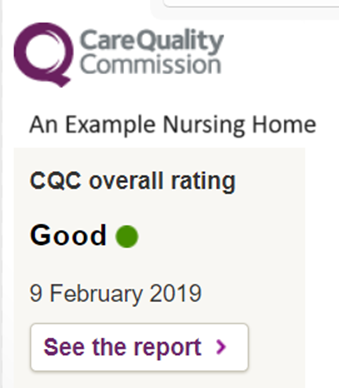
Do bear in mind that the report is a useful tool but does not always tell the whole story so be sure to discuss your findings whether good or bad with the home to get a better understanding of the home. See here for more information CQC ratings.
Online reviews and reputation of the care home
Unless you know someone who has knowledge of the home, the most common way of researching the home’s reputation will be by exploring the online reviews. Most care facilities reviews are written by the family of loved ones. These reviews could offer valuable feedback on how their family members were treated, the staff’s bedside manner, the food, available activities and general overall experience. You can usually find reviews for homes on Google reviews, Trustpilot or carehome.co.uk.
Ask your GP
Ask your GP if they have any recommendations or knowledge on local homes. Your GP might refer you to local care facilities based on your specific needs, budget, and location.
Use Compare Caring’s comparison tool
Whether you’ve already created your short list of potential care homes or need help finding facilities near you, Compare Caring’s convenient comparison tool can simplify this process. Simply enter your postal code or the postal code of the area you’re interested in and click “Find Care”. Compare Caring will find and compare care home facilities in the chosen area based on their fees, CQC ratings, and services offered. This tool is completely free, saving you the time and hassle of comparing countless facilities on your own.
Planning your visit
The only way to truly get a feel for each care home is by visiting it. Any facility worth your time will be more than happy to welcome you and your family in for a visit. If they’re a reputable residential care home with qualified staff and positive reviews, they’ll be eager to showcase their facility.
Make a short list of your top 2 or 3 choices for care homes near you and start making phone calls. Find out if you can visit for a tour or half a day. Many facilities will invite you and your family members to partake in lunch or dinner, communal events, and more to give you a better idea of how the facility operates daily.
What to look for when visiting the care home
A care home is only as good as its Manager and work force. Ask the Manager how long they have worked there for and what the average length of service is amongst the work force. This can be a good barometer of a healthy working environment. Good employee retention levels in a business are usually a good sign. Ask about the training that the Carers receive. If your loved one has a condition such as dementia, how do they cater for this?
You should feel when speaking to people that the staff are nurturing and friendly to both patients and visiting loved ones. Reputable and professional staff members will have no problem answering your questions, giving you a tour of the facility, or explaining their daily routines and activities. If the staff reacts defensively or refuses to explain their procedures or training, this may be a red flag.
When walking through the facility, are there any noticeable odors, does the environment look organised, do the residents seem content. Is the person showing you around engaging with the other residents by name. Good Care professionals show a genuine interest in their residents. They get to know them on a personal level and form true connections that allow for a more personalised and positive experience.
Accommodations and living quarters
Not all home care facilities offer the same accommodation. Some may have en-suites with a private bathroom and shower, while others offer shared bathrooms. Other accommodations include a dining room, lounge area, and fitness room. Enquire as to what exactly your loved one will have with regards to room size and bathroom access.
Some residential care facilities also have outdoor spaces including gardens, patios, and other seating areas. Other residents may be fortunate enough to have a door that leads to a balcony or outdoor seating area. If this is important to you or your loved one, be sure to ask how these arrangements are made or how rooms are selected and allocated.
Most care homes not only allow but encourage residents to add personal touches to their living space. The goal is to make residents feel at home and comfortable in their new living quarters. Ask about bringing in your own furnishings, bedding, and other personal items and possessions. Many facilities allow residents to bring everything from televisions and decorations to furniture and photos to create a warm, homely feel. If your loved one has dementia, see more on easing the transition into the care home.
Amenities, activities, and experiences offered in the care home
Many care homes offer a variety of amenities and activities for residents. This is their home now and their days should be filled with positive experiences, fun, laughter, and activities that support psychological, emotional, and physical well-being.
Communal areas are an important feature of any residential care or nursing home. Here is where residents can meet, converse, and socialize, which are all important aspects of a happy, quality life. See if the facility has activities and events planned for residents. These can include games, social gatherings, and themed events based on upcoming holidays. Participating in these types of activities creates a sense of normalcy for residents. Communal areas often have puzzles, books, and a television for residents to enjoy together.
These areas should be inviting and comfortable, creating a warm and positive atmosphere. Many family members meet and visit their loved ones in these spaces as well so they should feel welcome. The same can be said for outdoor areas like gardens and patios.
Other popular activities include crafts, exercise classes, art, music, and more. Some care homes even plan day trips to local museums, shopping centers, or theaters for those residents who are more mobile and able to travel outside the facility.
Accommodations and accessibility within the care home
For less mobile patients, having easily accessible entrances, exits, and communal areas is a must. The best care home near you should have ramps at all the entrances and exits, an elevator (if there are multiple floors), handicapped railings in the showers and bathrooms, and wide doorways and hallways to accommodate wheelchairs, walkers, and other equipment.
Many residential care homes are built for those with disabilities or mobility issues, but if you’re unsure, ask what types of accommodations the facility offers. Other important features include a large enough parking lot for family and visitors and close proximity to shopping centers and doctor’s offices. Find out if the care home has a shuttle or transportation services that bring residents to these local areas periodically.
Food quality within the care home
Nutrition plays an integral role in the overall health and well-being of patients. Not only that, but delicious food brings joy and happiness to most people. Residents should have access to nutritious and tasty meals that meet their requirements and preferences.
Most residential care homes have a full cafeteria with specially trained chefs who prepare nutritional meals according to the patient’s medical needs, taste buds, and other dietary requirements. Be sure to mention any food allergies you or your loved one have and don’t be afraid to ask for a sample menu or tasting before making your final decision. See more information on the importance of good nutrition with the care home.
See if the care home offers trial periods
Some care facilities offer trial periods for prospective residents. This gives you and your loved one the chance to see first-hand how it is to live day-to-day in a particular place. This is also another option for patients who only need temporary arrangements. Known as respite care, these short-term residencies let you explore the environment, try different activities, socialise, and see if the care home is a good fit.
Ask the facility if they offer respite care. Next, inquire about potential vacancies and if there’s a waitlist for new residents. Not all facilities offer short-term or respite care so be sure to ask this upfront before you get too deep into the planning process.
Importantly, don’t rush the process of picking your ideal care home
Choosing a care home for yourself or a loved one isn’t an easy choice. It takes plenty of time, effort, and research. You need to ensure the facility offers not only the services that your family requires, but also a high level of care that makes residents feel welcome, happy, and comfortable.
If you still need guidance on finding the best care home near you, let Compare Caring help. Using our free tool, all you need to enter is your postal code and a few requirements to discover the most suitable facilities in your area.
 Previous
